Discover TAP resources


In this section you can find the main resources developed by the Tropical Agriculture Platform (TAP)


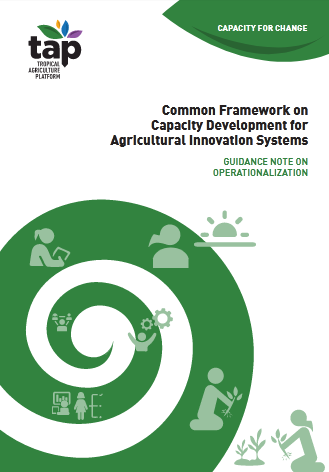
Common Framework Volumes


The Common Framework developed by TAP proposes a practical approach to development of capacities for agricultural innovation.
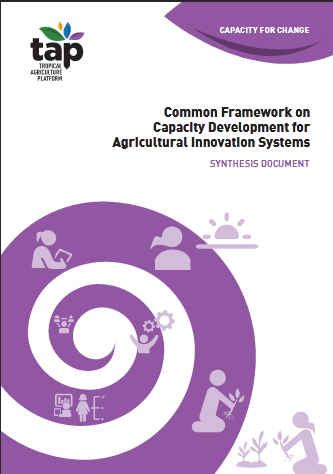
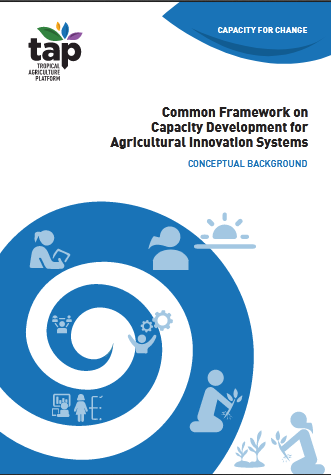
 

Conceptual Diagram of an Agricultural Innovation Systems
The 3 dimensions of Capacity Development
The 4 + 1 Capacities
Definitions
The Framework is composed of three volumes and provides concepts, principles, methodologies and tools to better understand the architecture of Agricultural Innovation Systems and to plan, implement, monitor, evaluate and bring coherence to the Capacity Development interventions.


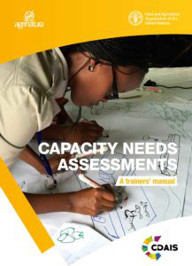
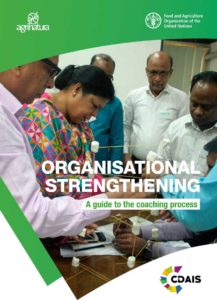
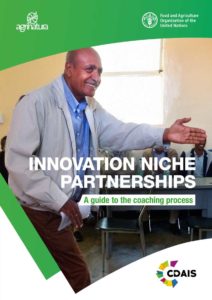
Capacity Development Manuals
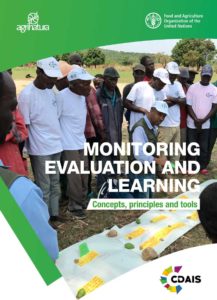
 

This trainers’ manual collection was produced as part the Capacity Development for Agricultural Innovation Systems (CDAIS) project. The project was implemented by Agrinatura and FAO in partnerhsip with national partners from eight pilot countries) focusing on strengthen the capacity of countries and key stakeholders to innovate in complex agricultural systems, thereby achieving improved rural livelihoods.
Tools
Tools
Tools
Tools
Tools
Tools


Herramientas de la TAP

La FAO, en colaboración con Agrinatura, ha producido una serie de hojas informativas que describen herramientas y enfoques para promover proyectos de desarrollo de capacidades para sistemas de innovación agrícola (AIS). Las herramientas están diseñadas con miras a la implementación práctica de los principios del Marco Común de la Plataforma de Agricultura Tropical (TAP). Estas herramientas han sido usadas en el proyecto CDAIS.
Otros recursos de TAP

Esta sección contiene otros recursos desarrollados por la Plataforma de la Agricultura Tropical, como herramientas de implementación práctica y hojas informativas para el Desarrollo de Capacidades, Historias de éxito de proyectos implementados, Carta de la TAP, informes anuales de la TAP y muchos más.

Tool factsheet: Social Network Analysis

Social Network Analysis is a practical and useful tool that looks at the linkages present in an innovation network and monitors their development over time. It maps the relationships between the stakeholders in the network and highlights the changes between them. This factsheet is part of a series outlining tools and approaches to promote capacity development projects for agricultural innovation systems (AIS). The tools described in these pages are designed with a view to the practical implementation of the principles of the Common Framework of the Tropical Agriculture Platform (TAP), a G20...
2017

Overview Stage 5: Implementation

Implementation is the final stage of the capacity development (CD) for agricultural innovation systems (AIS) cycle of the TAP Common Framework. The Cycle consists of five stages:1.Galvanizing Commitment, 2.Visioning, 3.Capacity Needs Assessment, 4.CD Strategy Development and 5.Implementation. The implementation phase builds on the previous realization of a CD strategy, including an action plan, based on the results of a capacity needs assessment. Those individuals or organizations who assume responsibility for a certain activity will be in charge of implementing the plan. Thi...
2017

Overview Stage 1: Galvanizing commitment

Galvanizing the commitment of agricultural innovation systems  (AIS) actors through learning, participation and reflection is a prerequisite for capacity development (CD) initiatives. This phase ensures both a common understanding of the process of CD for AIS as well as to create ownership and high-level support by those that head and lead representative bodies of actors within the system. This factsheet is part of a series outlining tools and approaches to promote CD projects for AIS. The tools described in these pages are designed with a view to the practical implementation of t...
2017

Tool factsheet: Scoping Study

The scoping study explores the nature and dynamics of the agricultural innovation system in order to disclose past and ongoing investments and mechanisms relating to AIS in the country. In particular, the study looks into the various initiatives and projects that support capacity development processes. This factsheet is part of a series outlining tools and approaches to promote capacity development projects for agricultural innovation systems (AIS). The tools described in these pages are designed with a view to the practical implementation of the principles of the Common Framework of the Tr...
2017

Overview Stage 2: Visioning

The visioning process brings together representatives of actor groups within the agricultural innovation systems (AIS) to build on their common understanding of AIS and the need for a coordinated approach. The process involves a wide spectrum of interested parties including ministries, legislative bodies and representatives of the private sector plus development partners and civil society. This factsheet is part of a series outlining tools and approaches to promote capacity development (CD) projects for AIS. The tools described in these pages are designed with a view to the practical i...
2017

Tool factsheet: Rich Picture

This tool is a simple tool to map out the current status of the AIS, and to discover where the actors want to go. The rich picture tool can be used both to describe the current situation and to illustrate future plans. A rich picture opens up discussions and helps participants reach a broad and collective understanding of the situation. This factsheet is part of a series outlining tools and approaches to promote capacity development projects for agricultural innovation systems (AIS). The tools described in these pages are designed with a view to the practical implementat...
2017

Tool factsheet: Timeline

The timeline tool is generally put to use when stakeholders embark upon the self-assessment phase of their innovation partnership. Stakeholders are asked to recall moments they feel were significant for the partnership, from its beginning to the present and to reflect upon how the partnership has evolved since it began. This factsheet is part of a series outlining tools and approaches to promote capacity development projects for agricultural innovation systems (AIS). The tools described in these pages are designed with a view to the practical implementation of the principles of the Common F...
2017

Tool factsheet: Capacity-focused Problem Tree

The capacity-focused problem tree pinpoints a core capacity issue, along with its causes and effects. It helps clarify the precise capacity-development objectives that the intervention aims to achieve. The focus should be on functional capacity, but room should be left to acknowledge technical capacity issues too. This factsheet is part of a series outlining tools and approaches to promote capacity development projects for agricultural innovation systems (AIS). The tools described in these pages are designed with a view to the practical implementation of the principles of the Common Framewo...
2017

Tool factsheet: Simulation Game

This tool enables participants to become cognisant of the functional capacities discovered through the capacity scoring questionnaire, and test the limits of these capacities through simulations or role-playing (e.g. problem-solving, collaboration, information sharing, and engagement). The simulation game leads to an intuitive understanding of innovation capacities and of the importance of the enabling environment, helping participants to learn about the significance of these capacities. This factsheet is part of a series outlining tools and approaches to promote capacity development projec...
2017

Burkina Faso: Stories of change. A marketplace of innovative ideas

The CDAIS ‘marketplace’ to promote agricultural innovations in Burkina Faso took place on 6 July 2017 in ouagadougou. It was a rich event involving more than 80 people who are working directly with, or interested in working with, different partnerships. The marketplace allowed stakeholders in the six selected partnerships to get to know and develop relationships with suppliers of agricultural support services. It also provided an opportunity for service suppliers and other participants to show their interest in accompanying the partnerships on their respective journeys....
2017