Recursos

  • Descubra los recursos de TAP
  • Descubra todos los recursos

En esta sección puede encontrar los principales recursos desarrollados por la Plataforma de Agricultura Tropical (TAP)


Marco Común de la Plataforma de Agricultura Tropical (TAP)


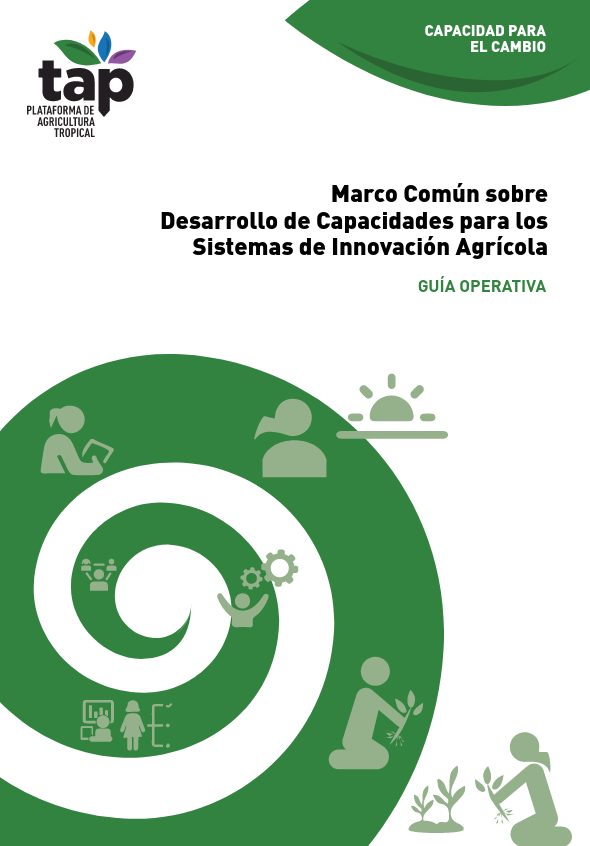
El Marco Común propone un enfoque práctico para el Desarrollo de Capacidades (DC) para la Innovación Agrícola.
 

Conceptual Diagram of an Agricultural Innovation Systems
The 3 dimensions of Capacity Development
The 4 + 1 Capacities
Definitions
El Marco se compone de tres volúmenes y proporciona conceptos, principios, metodologías y herramientas para una mejor comprensión de la arquitectura de los SIA, para evaluar las necesidades de DC y para planificar, implementar, monitorear y evaluar las intervenciones de DC.


Manuales de desarrollo de capacidades
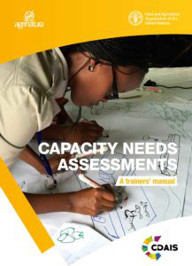
 

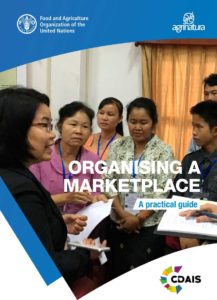
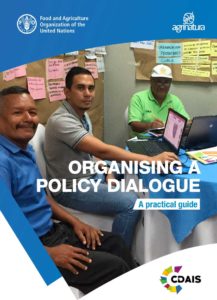
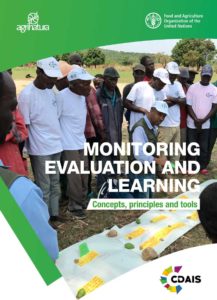
Esta colección de manuales para instructores se produjo como parte del proyecto Desarrollo de capacidades para los sistemas de innovación agrícola (CDAIS). El proyecto fue implementado por Agrinatura-EEIG y la FAO en asociación con socios nacionales de ocho países piloto y se centró en fortalecer la capacidad de los países y las principales partes interesadas para innovar en sistemas agrícolas complejos, logrando así mejores medios de vida rurales.
Tools
Tools
Tools
Tools
Tools
Tools


Herramientas de la TAP

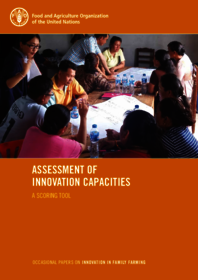
La FAO, en colaboración con Agrinatura, ha producido una serie de hojas informativas que describen herramientas y enfoques para promover proyectos de desarrollo de capacidades para sistemas de innovación agrícola (AIS). Las herramientas están diseñadas con miras a la implementación práctica de los principios del Marco Común de la Plataforma de Agricultura Tropical (TAP). Estas herramientas han sido usadas en el proyecto CDAIS.
Otros recursos de TAP

Esta sección contiene otros recursos desarrollados por la Plataforma de la Agricultura Tropical, como herramientas de implementación práctica y hojas informativas para el Desarrollo de Capacidades, Historias de éxito de proyectos implementados, Carta de la TAP, informes anuales de la TAP y muchos más.

Overview Stage 3: Capacity Needs Assessment

Capacity needs assessment is at the core of the cycle of the TAP Common Framework and it is fundamental to strengthening the agricultural innovation systems (AIS). The Assessment aims to ascertain the level of technical and functional capacity, and in particular the capacity to adapt and respond in the various dimensions.  The capacity needs assessment will provide an analysis across the sector to inform the setting of priorities and development of strategic capacity development (CD) interventions. This factsheet is part of a series outlining tools and approaches to promote CD pro...
2017

Tool factsheet: Scoring Innovation Capacities

This tool was designed to assess innovation capacities, identify strengths and weaknesses and monitor capacity changes over time. The scoring tool makes it clear which functional capacities are going to be needed to promote, lead or successfully participate in innovation processes. The tool evaluates capacities on the basis of 21 indicators (each of which is graded on a scale from 0 (low capacity) to 3 (high capacity), and build on the key innovation capacities identified in the capacity needs assessment. This factsheet is part of a series outlining tools and approaches to promote capa...
2017

Overview Stage 4: Capacity Development Strategy

The design of capacity development interventions is a crucial phase in the capacity development (CD) for agricultural innovation systems (AIS) cycle of the TAP Common Framework. Intervention planning follows from and builds on the visioning exercises and needs assessments carried out beforehand. Options for CD interventions will depend on the country context, ongoing programmes and funding opportunities. Prioritization should also include identification of activities that can take off immediately. This factsheet is part of a series outlining tools and approaches to promote CD proj...
2017

Tool factsheet: Social Network Analysis

Social Network Analysis is a practical and useful tool that looks at the linkages present in an innovation network and monitors their development over time. It maps the relationships between the stakeholders in the network and highlights the changes between them. This factsheet is part of a series outlining tools and approaches to promote capacity development projects for agricultural innovation systems (AIS). The tools described in these pages are designed with a view to the practical implementation of the principles of the Common Framework of the Tropical Agriculture Platform (TAP), a G20...
2017

Overview Stage 5: Implementation

Implementation is the final stage of the capacity development (CD) for agricultural innovation systems (AIS) cycle of the TAP Common Framework. The Cycle consists of five stages:1.Galvanizing Commitment, 2.Visioning, 3.Capacity Needs Assessment, 4.CD Strategy Development and 5.Implementation. The implementation phase builds on the previous realization of a CD strategy, including an action plan, based on the results of a capacity needs assessment. Those individuals or organizations who assume responsibility for a certain activity will be in charge of implementing the plan. Thi...
2017

Overview Stage 1: Galvanizing commitment

Galvanizing the commitment of agricultural innovation systems  (AIS) actors through learning, participation and reflection is a prerequisite for capacity development (CD) initiatives. This phase ensures both a common understanding of the process of CD for AIS as well as to create ownership and high-level support by those that head and lead representative bodies of actors within the system. This factsheet is part of a series outlining tools and approaches to promote CD projects for AIS. The tools described in these pages are designed with a view to the practical implementation of t...
2017

Tool factsheet: Simulation Game

This tool enables participants to become cognisant of the functional capacities discovered through the capacity scoring questionnaire, and test the limits of these capacities through simulations or role-playing (e.g. problem-solving, collaboration, information sharing, and engagement). The simulation game leads to an intuitive understanding of innovation capacities and of the importance of the enabling environment, helping participants to learn about the significance of these capacities. This factsheet is part of a series outlining tools and approaches to promote capacity development projec...
2017

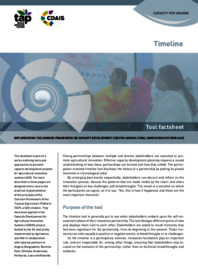
Tool factsheet: Timeline

The timeline tool is generally put to use when stakeholders embark upon the self-assessment phase of their innovation partnership. Stakeholders are asked to recall moments they feel were significant for the partnership, from its beginning to the present and to reflect upon how the partnership has evolved since it began. This factsheet is part of a series outlining tools and approaches to promote capacity development projects for agricultural innovation systems (AIS). The tools described in these pages are designed with a view to the practical implementation of the principles of the Common F...
2017

Tool factsheet: Capacity-focused Problem Tree

The capacity-focused problem tree pinpoints a core capacity issue, along with its causes and effects. It helps clarify the precise capacity-development objectives that the intervention aims to achieve. The focus should be on functional capacity, but room should be left to acknowledge technical capacity issues too. This factsheet is part of a series outlining tools and approaches to promote capacity development projects for agricultural innovation systems (AIS). The tools described in these pages are designed with a view to the practical implementation of the principles of the Common Framewo...
2017

Ethiopia: A story of change. Feed safety - change through learning

Ethiopia has more livestock than any other country in Africa. The sales of meat, milk and other animal products from 57 million cattle, 29 million sheep, 29 million goats, 7 million donkeys, 2 million horses, a million camels and half a million mules make up one-quarter of national gross domestic product (GDP), 45% of agricultural GDP, and provide 16% of foreign earnings from the export of live animals, hides and skins. In addition, but more difficult to measure, is the work these animals provide, for ploughing, threshing, and transporting farmers, families and farm products to mar...
2017

Espacio de descubrimiento


Las herramientas de búsqueda de TAPipedia permiten a los socios de TAP y otras partes interesadas compartir sus propios recursos de Desarrollo de Capacidades (CD) aplicados y específicos al contexto para los Sistemas de Innovación Agrícola (AIS) y descubrir dicho conocimiento de diferentes fuentes y regiones.


EDITOR